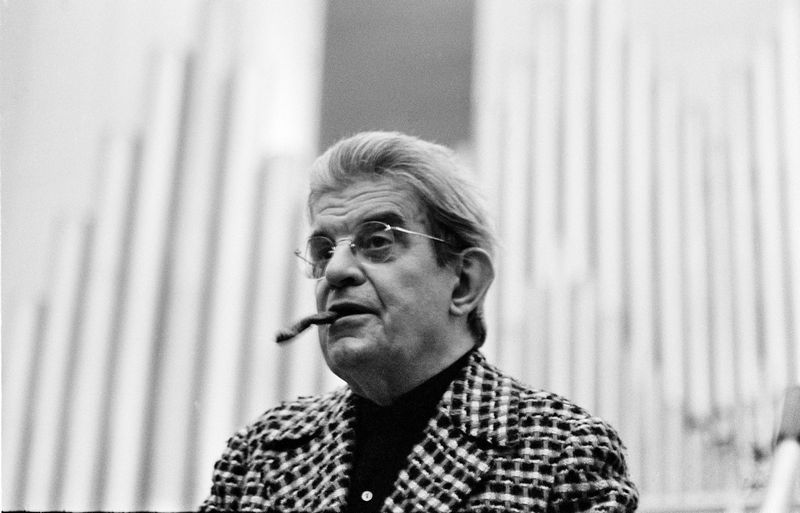
This will be a strikingly simple exploration of an idea I came to while attempting to clarify and sort out my thoughts on some of the broadest things. I find that people often ask, “what is philosophy?”, “what is art?”, and “what is/are the aim(s) of science?”, and I have never heard an adequate answer to any of these questions except that they are bad questions. Understanding why they seem to be bad questions has been a difficulty for me and many similarly confused thinkers. With the categories of Jacques Lacan’s thought I managed to come up with a response that precludes any answers but satisfies the itch to say something about these domains. This thought centers on Lacan’s notion of the objet a, the object cause of desire, and the general idea of the Thing or the Truth. These three disciplines, philosophy, art and science, all see themselves as getting at the Thing, the Real or some kind of truth in their own ways but they are each often incompatible discourses. For Lacan the objet a takes on three relations to desire, protraction, subtraction and obstruction, and to help myself think clearly, I have found it fruitful to use this framework to describe philosophy, art and science.
First, each domain tries to get at something that can most generally be called “The Thing” though it is variously “The Truth”, “The Representation” or something like what is “really going on”. The most obvious point to make is that each of these disciplines fundamentally fails at receiving its object, hence their continued interest to our imagination and ways of life. If any of these disciplines succeeded we could easily answer its question through ostension, “there it is! that’s what it was all about!”. Now our response to the question of each of these domains is also quite obviously a sort of forced attempt to view them from the perspective of their relations and their problems. Somebody from inside of each domain has some answer to the question that would offer the perspective of a philosopher, an artist or a scientist. The strength of viewing each discipline in terms of what it “wants” is that we don’t have to give a final answer; instead, we can treat each domain as a subject with no final or definite form.
Philosophy as a domain can be thought of as always having the object of its desire protracted from its pursuit. Every systematic philosophy has seen itself as close to or right on top of its object but every single one has failed to have the final word. Beyond this, every philosophy so far has shown other avenues to its object, it has moved its object by approaching it. This is what happened most clearly following Plato, Kant and the logical positivists, as each gets closer to Truth it reveals an unexpected aspect of its pursuit that becomes a pursuit on its own. It constantly opens up sub-disciplines expanding the question of what philosophers are dealing with. This leads philosophers to address increasingly particular and pedantic questions. It is always kept from its answer by questions hidden in the form and content of every answer it has already given. For instance, we presumably began with questioning being or the gods or something similarly vague then ethics somehow, somewhere emerged and began its journey with the eudaemonistic question “what is the best life?”, but this led us to ask “what makes a life capable of being evaluated?”, which leads to the question of the “value of modes of evaluation” and up to the present we have centered on “what makes a life worth living?”. This movement could be summarized as going from eudaemonistic ethics, to questions of morality, to meta-ethics and finally to the question of well-being. There have always been questions of ethics but they have been approached in so many diverse ways that trying to say they all address the same question or object would be absurd.
I will save art for last and evaluate science now as a domain kept from its fulfillment by obstruction. For the scientific mind, the object of its desire is always right on the other side, out there in the “real world” never changing and always waiting. There is always one more experiment or theory that will pin everything together and give us that final word. The problem for science is that it wants the thing but can only have the representation, story or description and never the explanation itself. Science concerns itself with questions that can be put up against particles while philosophy will take on the questions that may not be questions at all as they are subject to all of the vagaries of discourse. To see this clearly we can think about the long history of atomism. While the atoms of Democritus and Leucippus are nothing like the atoms of today’s understanding they were still the object of discourse and we could explain our understanding of them to an ancient Athenian even if we can’t fundamentally explain them at all. These have always been thought of as the constituents of matter, their descriptions have changed but the named entity has not. Another easy example would be gravity. With Einstein gravity didn’t change we just “got closer” to it though we still can’t exhaustively explain the phenomenon. Unlike these examples, in philosophy sometimes our question may actually change the thing we are questioning; for instance, after Kant reason may never be the same and with Descartes the mental underwent some nuanced transformations, hence the movement of not just the questions but the objects themselves.
Finally art is the domain kept from its object by subtraction, it simply isn’t there. This is easy enough to understand, there is no “truth” to a work of art, no final word. Artists rarely even presume to talk about such things as they are apt to see it as a matter of perspective. Now each of these three domains could be said to be relative to some perspective, but the difference is the resolution of these perspectives. Science is relative to the human perspective, our measurements are only comprehensible when relatable to our bodily dimensions and cognitive capacities in some way, we can’t conceive of picometers in themselves but we can think of meters and relate them by a factor of 10-12. In philosophy we have every concept relative to its language game, apropos Wittgenstein, that is to say relative to the perspective of a particular cultural or discursive domain. In art we have the object related to an artist and a spectator, neither perspective taking primacy, an artist’s least liked work can have the largest impact on viewers. Every artistic perspective necessarily presupposes a cultural and human perspective so that scientific and philosophical analyses spill through, but it also has that silent surplus that makes it awesome, awful and awe-inspiring. No artwork has a reason for existing, to try to give it one is always absurd and perverts the object into something unartistic and merely useful or necessary. This may make art the most human, powerful and unique discipline as it gives us the power to want something that never was there, that we have no reason to want. This opens up our powers for creation and reconfiguring what is.
This leads me to an auxiliary analysis on these three domains using two of the most famous triads in the history of philosophy, Hegel’s dialectic and Nietzsche’s three metamorphoses. I am motivated to do this by my reading of Delueze’s “Nietzsche and Philosophy” which characterizes Nietzsche as the anti-Hegelian philosopher. This reading, however, does not wholly oppose Hegel’s thought to Nietzsche’s, but instead shows a nuance that can be drawn from their slight difference to enrich both interpretative frameworks. In both movements we go from philosophy to science and finally to art. With Hegel we have philosophy as the domain of abstraction speculating on what “is” indiscriminately so that what “is” moves around and slips away under our blade. Philosophy conjures up various concepts that need to be later tested against science and art to determine their lasting value. With science we come to the negation of this discipline and its object(s) to say that only what is not abstract “is”. Science is “the measure of all things” that determines which concepts get to count as things and which do not. Finally we arrive at the negation of the negation, the concrete realization that what we were doing all along was an act of creation, an unmaking of the unreality of what “is not” and thus acting through artistic invention. This is the concrete universal that reveals the movements centering on an absent object all along. Artistic creation is the creation of “appearance qua appearance”. This roughly parallels the movement from sense-certainty through perception to self-consciousness or the triad of “Understanding – Reason – Spirit” in Hegel. Opposed to this is the triad of camel, lion, and child. Here we begin with the “ye-a of the ass” that Deleuze equates to the attitude of the camel, the indiscriminate affirmation of what is. This is the naive yes saying of philosophy that takes on all contenders, pretending they are all worth taking on. Philosophy bends down to drink from every pool and puddle. Science on the other hand is the “holy no” the force that says most of this is all nonsense. The voice of science is the voice of the skeptical denial of everything human that has come before. This leads us to the final stage which is where the difference with the dialectic is most poignant, the child. We have here the fully creative force, instead of negating negation or any such thing, for Nietzsche art doesn’t just make real what was previously unreal but it makes real what was previously not even unreal. The force of the child artist is a purely active force, not simply reacting to what has not been done yet but actively carving out a domain of action that hasn’t even opened up until it is repeated. For Nietzsche art sustains and maintains life, it gives life its buoyancy and enthalpy allowing it to push on the universe and posit difference in itself.
My aim has not been to argue that these domains are wholly separate but only to show that each can be characterized with a unique orientation and desire. For my analysis I have relied heavily on Lacan and thus on Slavoj Zizek, particularly “The Sublime Object of Ideology” and “Less than Nothing”. For a quick overview or refresher on Lacanian ideas www.nosubject.com is the best internet resource I know of. Lastly for my quick brush on a Nietzchean eye view I relied primarily on Deleuze’s aforementioned book, “Nietzsche and Philosophy”. For a look at most concepts relevant to philosophy I always recommend the Stanford Encyclopedia of Philosophy.
 Snake Swallower
Leave a comment